
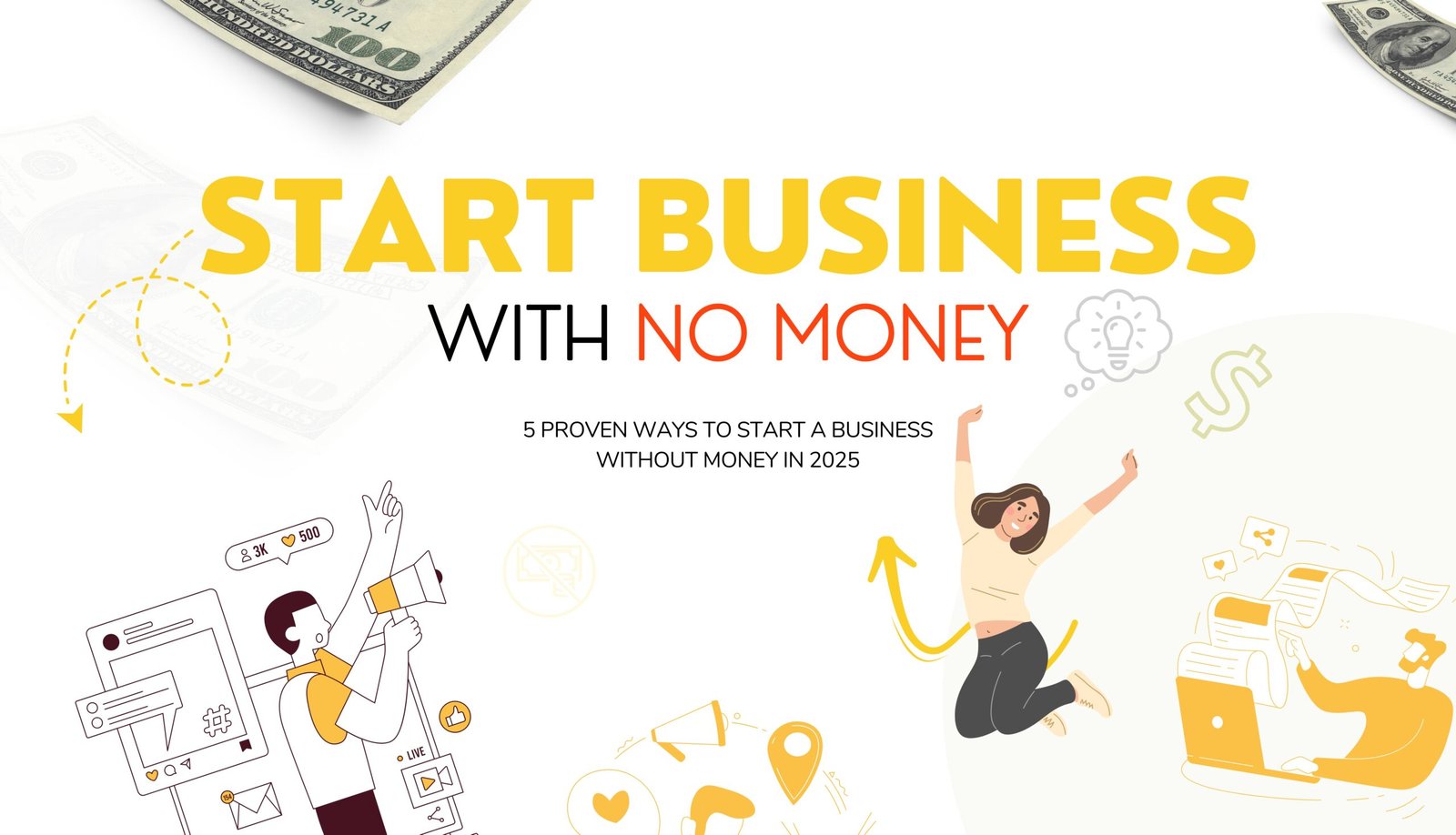
5 Businesses You Can Start With No Money in 2026 (Even If You Have No Experience)
Starting a business does not always require thousands of dollars, a rented office, expensive equipment, or a large amount of capital. Sometimes, what you need most is a valuable skill, a smartphone, internet access, and the willingness to solve a problem people are already paying to fix.
For many aspiring entrepreneurs, the biggest challenge is not a lack of business ideas. It is the belief that they must first raise money before they can start making money.
The truth is that some businesses can be started with little to no additional financial investment, especially when you already have access to a phone, a computer, internet access, or a skill you can monetize.
If you have been searching for businesses you can start with no money, profitable small business ideas for beginners, or ways to make money without capital, this guide explores five practical business models you can start with limited resources.
Whether you are a student, an unemployed graduate, a 9–5 professional looking for extra income, or someone who wants to become financially independent, these opportunities can provide a starting point.
Can You Really Start a Business With No Money?
Yes, but there is an important distinction.
Starting a business with no money does not necessarily mean operating without any costs whatsoever. It means starting without putting significant money upfront into inventory, office rent, equipment, or paid advertising.
You may still need internet access, electricity, transportation, software, or time. You can reduce financial pressure by using tools you already have, starting from home, collecting deposits where appropriate, and reinvesting your first earnings.
The smartest approach is to start with a service business because you can often sell your skills before spending money on business infrastructure.
Here are five businesses worth considering.
1. Freelance Writing and Content Creation
One of the easiest service businesses to start without buying inventory is freelance writing and content creation.
Businesses, entrepreneurs, creators, and organizations constantly need content to attract networks, educate their audiences, build trust, and sell their products.
Many of them have ideas but lack the time, skill, or consistency required to turn those ideas into useful content.
That creates an opportunity.
What exactly can you offer?
You do not have to become a professional author or journalist before starting.
You can specialize in services such as:
Blog writing for business websites.
LinkedIn posts for founders and executives.
Website copywriting for small businesses.
Email newsletters and marketing campaigns.
Social media captions and content calendars.
Video scripts for TikTok, Instagram Reels, and YouTube.
SEO articles targeting specific search terms.
Instead of advertising yourself as someone who writes everything, consider choosing one service and one target audience.
For example, you could specialize in writing SEO blog posts for real estate businesses, LinkedIn content for consultants, or email campaigns for online stores.
Specialization makes it easier for potential networks to understand what you do.
How to start freelance writing with no money
Step 1: Choose a niche.
Pick an industry you understand or are willing to research. Finance, technology, health, education, real estate, and business are possible options.
Step 2: Create three samples.
Write three strong pieces that demonstrate your ability. You can publish them on free platforms or share them as documents.
Do not pretend sample work was commissioned by a client if it was not.
Step 3: Find potential clients.
Look for businesses publishing inconsistent content, founders with inactive LinkedIn pages, or websites with outdated blog sections.
Use LinkedIn, business directories, professional communities, and your existing network to identify prospects.
Step 4: Send personalized offers.
Do not simply message people saying you are looking for work.
Identify a specific content opportunity and explain how you can help.
Step 5: Deliver and collect testimonials.
Start with a clearly defined project, agree on the fee and deadline, and request feedback after delivery.
How does freelance writing make money?
You can charge per article, project, monthly package, or content campaign.
For illustration, if you secure four clients paying ₦75,000 per month for a defined content package, that represents ₦300,000 in monthly revenue before expenses.
This is an example, not a guaranteed income or standard market rate. Your actual pricing depends on your expertise, deliverables, client budgets, and results.
Who should start this business?
Freelance writing is suitable for people who communicate well, enjoy research, understand audiences, and can meet deadlines.
It is also a useful business for people who want to work remotely and gradually build a client base.
Long-tail keyword opportunities:
How to start freelance writing with no money
How to make money writing blog posts for businesses
Freelance writing business ideas for beginners
How to get content writing clients without experience
2. Social Media Management
Social media management is another business you can start with little or no upfront capital.
Thousands of businesses want visibility online but struggle to maintain consistent, engaging, and strategic content.
Some business owners post occasionally without a clear plan. Others have pages but rarely respond to comments, messages, or customer inquiries.
You can help them manage that process.
What does a social media manager do?
Depending on your agreement with a client, your services could include:
Developing monthly content strategies.
Creating post calendars.
Writing captions and content hooks.
Designing basic graphics using free tools.
Scheduling posts.
Monitoring comments and messages.
Reviewing performance analytics.
Researching audience interests and competitors.
Repurposing existing videos and articles.
However, social media management is not simply posting pictures every day.
Businesses pay for organization, consistency, communication, audience understanding, and ultimately, support for their commercial goals.
You should be clear about what is included in your service and what is not. Paid advertisements, influencer fees, photography, and video production may require separate budgets.
How to start a social media management business
Step 1: Select a business category.
Choose a market you can understand and reach.
Examples include restaurants, fashion brands, beauty businesses, real estate agents, coaches, professional services, or local retailers.
Step 2: Audit potential clients’ pages.
Identify businesses with inconsistent posting, unclear messaging, weak content presentation, or poor organization.
Avoid criticizing them aggressively. Focus on opportunities.
Step 3: Create a sample content plan.
Prepare a seven-day content calendar for a hypothetical business or clearly label it as an unsolicited sample.
Include content topics, captions, and calls to action.
Step 4: Reach out directly.
Contact business owners through professional channels. Offer a specific improvement rather than a vague promise to grow their account.
Step 5: Sell a manageable package.
Start with a defined monthly package, such as a certain number of posts, captions, and a monthly report.
Agree on approval processes, payment terms, access permissions, and responsibilities before beginning.
How much can you earn from social media management?
Suppose you manage three businesses and each pays ₦100,000 monthly for an agreed scope of work.
That would equal ₦300,000 in monthly revenue before expenses.
The challenge is that client management can become time-consuming. You must price based on workload, complexity, revisions, and the level of responsibility involved.
A client paying more is not necessarily more profitable if the work requires significantly more hours.
How to get your first social media management client
Your first client does not have to come from advertising.
Start with businesses in your network, entrepreneurs you already know, referrals, and carefully selected direct outreach.
You can also demonstrate your skills by growing a personal page and documenting your content strategy, experiments, and lessons.
The objective is to show potential networks that you understand more than just how to publish a post.
Long-tail keyword opportunities:
How to start a social media management business with no money
How to get your first social media management client
Social media management business for beginners
How to manage Instagram accounts for small businesses
How to make money managing social media pages
3. Virtual Assistant Business
A virtual assistant business is an opportunity for people who are organized, dependable, detail-oriented, and comfortable using digital tools.
Many entrepreneurs and small business owners are overwhelmed by administrative work.
They spend hours answering emails, updating spreadsheets, scheduling appointments, organizing customer information, following up with leads, and preparing documents.
A virtual assistant helps take these responsibilities off their hands.
Unlike businesses that require physical stock, a virtual assistant business can often be started using a computer, an internet connection, and free or existing productivity tools.
Services you can offer as a virtual assistant
Your services can include:
Email inbox organization.
Calendar and appointment management.
Data entry and spreadsheet updates.
Customer support.
CRM updates and contact management.
Lead research and database organization.
Meeting notes and documentation.
Travel research and scheduling.
Basic reporting.
Follow-up coordination.
You can eventually specialize in a more valuable service, such as CRM management, executive assistance, customer success support, or sales operations assistance.
Specialized services can help distinguish you from general administrative assistants.
How to start a virtual assistant business from home
Step 1: Identify your strongest administrative skills.
You may already know how to use Google Workspace, Microsoft Excel, Notion, Trello, HubSpot, or similar tools.
You do not need to master every platform.
Step 2: Define your offer.
Instead of saying, “I can do anything,” create a clear offer.
For example:
“I help small businesses organize their customer databases, update their CRM, and maintain accurate sales follow-up records.”
Step 3: Create a simple portfolio.
Show a sample spreadsheet, a sample workflow, or a demonstration of how you would organize a customer pipeline.
Use fictional data and never expose confidential customer information.
Step 4: Find business owners who need support.
Look for founders, consultants, agencies, and small businesses with recurring administrative demands.
Step 5: Start with a paid trial project.
A small, clearly scoped project gives both parties an opportunity to assess whether the working relationship is suitable.
How does a virtual assistant make money?
You can charge hourly, per task, per project, or through monthly retainers.
For example, two clients paying ₦150,000 per month for defined support packages would produce ₦300,000 in monthly revenue before expenses.
Be careful about accepting unlimited tasks under a fixed monthly fee. Define working hours, response times, deliverables, and exclusions.
Also, protect client passwords, customer information, and business documents. Use authorized access and secure practices.
Is virtual assistance a good business for beginners?
It can be a strong entry point because you can begin with skills you already possess and expand as you gain experience.
The best long-term opportunity is to become known for solving a particular operational problem, not merely completing miscellaneous tasks.
Long-tail keyword opportunities:
How to start a virtual assistant business with no money
Virtual assistant jobs and business ideas for beginners
How to become a virtual assistant from home
How to find virtual assistant clients without experience
Virtual assistant services small businesses need
4. Online Tutoring and Skills Coaching
If you have a skill that other people want to learn, you may already have the foundation for a business.
People pay to acquire knowledge, improve their careers, solve problems, and develop practical abilities.
You do not necessarily need to build an online academy, purchase recording equipment, or create a sophisticated website before getting started.
You can begin with one learner and one clearly defined outcome.
What can you teach?
Possible areas include:
Mathematics and school subjects.
English language and writing.
Excel and spreadsheet skills.
Basic data analysis.
Graphic design.
Website design.
Digital marketing.
Career preparation and interview skills.
Professional software training.
Trading education and financial literacy, within appropriate boundaries.
Your offer should reflect your actual competence. Do not claim qualifications, professional experience, or results you cannot substantiate.
For sensitive or high-stakes areas, clearly communicate the educational scope and avoid promising outcomes.
For instance, trading education should not promise guaranteed profits, employment, financial independence, or successful prop-firm challenges.
How to start an online tutoring business with no capital
Step 1: Choose a specific learner.
A focused audience is easier to serve.
For example:
University students learning Excel.
Small business owners learning digital marketing.
Beginners learning website design.
Job seekers improving interview skills.
Step 2: Create a specific learning outcome.
Instead of selling “digital marketing lessons,” offer a practical program such as:
“Learn how to build a simple content calendar and measure basic social media performance.”
Step 3: Create a short curriculum.
Break the topic into lessons with practical exercises.
Your curriculum does not need to be complicated. Start with a small, useful learning experience.
Step 4: Get your first students.
Use referrals, LinkedIn, WhatsApp, community groups, and relevant professional networks.
You can offer a free introductory session while charging for the actual training.
Step 5: Improve the program.
Collect feedback, identify where learners struggle, and refine the material.
Over time, you can move from one-on-one sessions to group classes, workshops, recorded resources, or memberships.
How much can you make from online tutoring?
Consider a simple example.
If you teach ten students a course priced at ₦20,000 each, you generate ₦200,000 in gross course revenue for that cohort.
However, attracting students, preparing lessons, supporting learners, and processing payments all take time and may involve costs.
Your results will depend on the value of the training, demand, trust, pricing, and your ability to reach the right audience.
How to make this business scalable
Tutoring begins as a service, but it can evolve.
You can build:
Group coaching programs.
Paid workshops.
Downloadable templates.
Learning communities.
Subscription-based educational resources.
Corporate training services.
The key is to validate demand before investing heavily in a large course or learning platform.
Long-tail keyword opportunities:
How to start an online tutoring business with no money
How to make money teaching skills online
Online coaching business ideas for beginners
How to start teaching Excel online
How to sell online courses without a website
5. Commission-Based Sales and Lead Generation
If you are comfortable communicating with people, researching potential networks, and following up on opportunities, commission-based sales and lead generation can be another business to consider.
Many companies struggle to consistently find qualified prospects.
They may have a good product or service but lack the time or systems required to identify suitable buyers, start conversations, qualify interest, and arrange sales meetings.
That creates an opportunity for someone who can support their customer acquisition process.
What services can you provide?
Depending on your abilities and the client’s needs, you can offer:
Prospect research.
Lead list building.
Customer segmentation.
B2B lead generation.
Appointment setting.
Sales pipeline management.
CRM data cleaning.
Sales follow-up support.
Outreach campaign coordination.
You can charge a fixed fee, a project fee, a retainer, a commission, or an agreed combination.
For beginners, a defined service fee may be easier to manage than relying entirely on commission.
What is commission-based selling?
In a commission arrangement, you receive an agreed payment when a qualifying sale occurs or another clearly defined outcome is achieved.
For example, a company might agree to pay you a commission for each completed sale that meets specific conditions.
Before starting, clarify:
What counts as a qualified lead or completed sale?
When does the commission become payable?
How are cancellations and refunds handled?
How will sales be attributed to your work?
What reporting will you receive?
Who pays for tools, phone calls, or advertising?
Put the agreement in writing.
Avoid businesses that require you to pay questionable registration fees or recruit people as the main path to earning commissions.
You should also comply with applicable privacy, marketing, and anti-spam requirements when collecting or contacting prospects.
How to start a lead generation business with no money
Step 1: Choose an industry.
Examples include marketing agencies, software companies, recruitment firms, professional services, or other legitimate businesses with a clear customer profile.
Step 2: Understand their ideal customer.
You need to know who they want to reach, what problems those networks have, and why they would consider the offer.
Step 3: Build a small sample prospect list.
Use lawful, publicly available business information and the client’s approved targeting criteria. Keep the sample relevant and accurate.
Step 4: Approach potential clients.
Explain the problem you can help solve and show a small sample of your research or proposed process.
Step 5: Start with a measurable pilot.
Agree on a manageable scope and realistic performance measures.
Measure the quality of the leads and the commercial outcomes, not just the number of contacts collected.
How profitable is lead generation?
Imagine you secure three clients on a monthly service fee of ₦120,000 each.
That produces ₦360,000 in monthly revenue before operating expenses.
This is an illustrative pricing scenario, not a promise of what new providers will earn.
Results will depend on your niche, prospecting skills, conversion quality, service scope, and ability to retain networks.
Why this business has growth potential
Lead generation can develop into a specialized sales development agency.
As your experience increases, you may expand into:
Sales operations.
CRM implementation.
Appointment-setting teams.
Sales process consulting.
Customer acquisition strategy.
The strongest positioning is not simply “I sell leads.” It is “I help businesses build a more consistent and measurable pipeline of qualified sales opportunities.”
Long-tail keyword opportunities:
How to start a lead generation business with no money
How to make money finding networks for businesses
Commission-based sales business ideas for beginners
How to get clients for a lead generation business
B2B lead generation services for small businesses
Which of These Five Businesses Should You Start?
There is no single best business for everyone. Your best option depends on what you can do, what people are willing to pay for, and how quickly you can reach potential networks.
Here is a practical comparison.
| Business | Best suited for | Main challenge |
|---|---|---|
| Freelance writing | Strong writers and researchers | Standing out and finding clients |
| Social media management | Creative and strategic communicators | Managing expectations and workload |
| Virtual assistant | Organized, dependable people | Competing on value, not price |
| Online tutoring | People with teachable skills | Building trust and attracting students |
| Lead generation | Research-oriented salespeople | Delivering qualified opportunities |
If you already have a marketable skill, begin there rather than learning an entirely new business model simply because it sounds profitable.
A business that matches your existing strengths may be easier to launch and less expensive to validate.
A Practical 7-Day Plan to Start a Business With No Money
You do not need to spend the next three months planning a business.
You can use the next seven days to test whether someone is willing to pay for what you offer.
Day 1: Pick one business model
Choose one service, one audience, and one problem to solve.
Do not launch all five businesses simultaneously.
Day 2: Define your offer
Write one clear sentence explaining what you do, who you help, and the outcome you support.
Example:
“I help small businesses organize their sales pipelines and follow up with potential networks using simple CRM systems.”
Day 3: Create proof of your ability
Prepare a sample, demonstration, portfolio, mini-project, or short case study.
If you have previous experience, use real results only when they are accurate and you have permission to share them.
Day 4: Identify 30 potential networks
Build a relevant prospect list.
Focus on businesses or individuals who are likely to need your service and have a realistic ability to pay.
Quality matters more than collecting hundreds of random names.
Day 5: Start conversations
Reach out to a manageable number of qualified prospects with personalized messages.
Ask questions, identify needs, and explain how your service could help.
Day 6: Follow up and make offers
Respond to interested prospects, clarify scope, and send straightforward proposals.
Where appropriate, offer a small paid pilot rather than a large commitment.
Day 7: Review your results
Track:
Prospects contacted.
Replies received.
Conversations started.
Proposals sent.
Deals closed.
Common objections.
If nobody responds, improve your targeting and message before assuming the business idea cannot work.
A seven-day plan is enough to begin testing demand, but not necessarily enough to build a stable business.
Common Mistakes to Avoid When Starting a Business With No Money
Starting lean is useful, but there are mistakes that can make the process unnecessarily difficult.
1. Trying to sell everything.
When you offer ten unrelated services, people may struggle to understand what you are actually good at. Start with one clear offer.
2. Spending money before validating demand.
You do not need an expensive logo, office, website, or branding package before finding your first customer.
3. Working indefinitely for free.
Free samples can demonstrate competence, but they should not become unlimited unpaid work. Define boundaries and move toward paid engagements.
4. Promising unrealistic results.
Do not guarantee sales, viral content, trading profits, or overnight success. Focus on deliverables and measurable objectives you can reasonably influence.
5. Ignoring cash flow.
Revenue is not profit. Track expenses, payment dates, taxes, and outstanding invoices. Consider deposits or milestone payments for project work.
6. Failing to build relationships.
A satisfied customer may become a source of repeat work, referrals, and valuable feedback. Protect your reputation by communicating clearly and delivering reliably.
7. Treating every opportunity as a good opportunity.
Some clients have unrealistic expectations, unclear requirements, or poor payment practices. Choose engagements carefully and document agreements.
Final Thoughts: You May Not Need Capital as Much as You Need a Starting Point
The idea that you must have money before you can build a business keeps many talented people waiting.
But a business does not have to begin with a shop, an office, expensive equipment, or a team.
It can begin with a simple service, a useful skill, a conversation, and one customer who has a problem you can solve.
Freelance writing, social media management, virtual assistance, online tutoring, and lead generation all offer possible starting points for aspiring entrepreneurs with limited resources.
Choose one. Learn the market. Build proof. Talk to networks. Deliver value. Reinvest carefully.
And remember: the goal is not just to start a business with no money. The goal is to build a business that can eventually generate sustainable income, create opportunities, and give you greater control over your future.